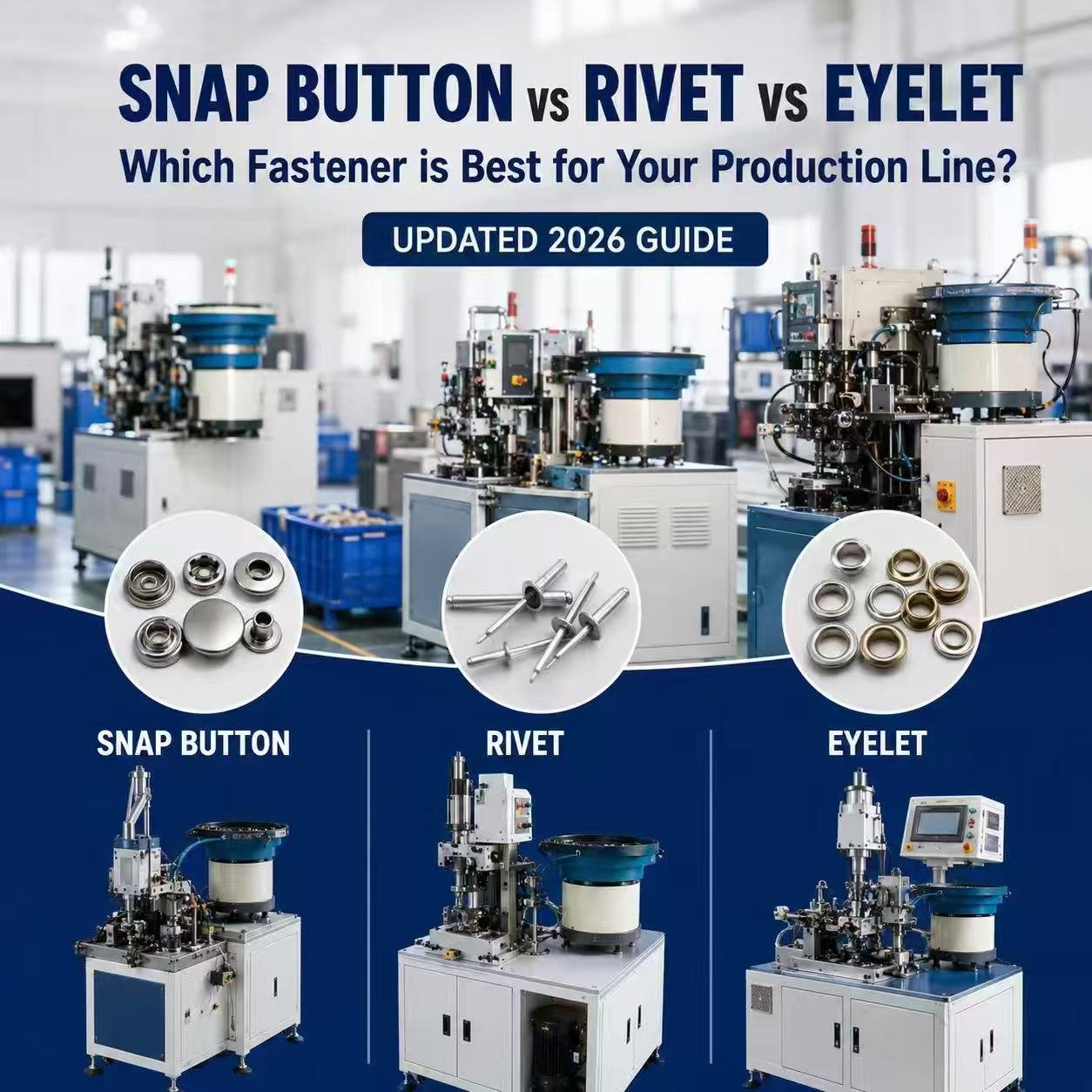
Snap Button vs Rivet vs Eyelet: Which Fastener is Best for Your Production Line? (Updated 2026 Guide)
Are you struggling to choose the right fastener and installation equipment for your manufacturing line? Selecting the wrong combination can lead to weak products, damaged materials, and expensive downtime. In this complete guide, the Hengzanxin (HZX) Industrial Team breaks down the differences between snap buttons, rivets, and eyelets to help you maximize your production efficiency.
Table of Contents
- 1. Introduction: Why the Right Fastener (and Machine) Matters
- 2. Understanding the Basics of Snap Buttons, Rivets, and Eyelets
- 3. Snap Buttons: Reusable Convenience for Modern Products
- 4. Rivets: Maximum Strength for Permanent Fastening
- 5. Eyelets: Hole Reinforcement and Protection Experts
- 6. Direct Comparison: Snap Button vs Rivet vs Eyelet
- 7. Industry-Specific Application Guide
- 8. The Critical Role of Professional Installation Machinery
- 9. HZX Riveting and Automation Solutions Advantage
- 10. Installation Best Practices for Snap Buttons, Rivets, and Eyelets
- 11. FAQ
- 12. Conclusion: Partner with HZX for Smarter Fastening Solutions
1. Introduction: Why the Right Fastener (and Machine) Matters
Every year, factories lose money because of bad fastening choices. You might choose a great fastener, but your machine might fail. Or you might buy an expensive machine for the wrong type of metal part. Which hardware choice will actually lower your production costs and stop factory defects?
We see this problem all the time. A factory wants to join two pieces of heavy material. They pick a small eyelet instead of a heavy-duty industrial rivet. The joint breaks during shipping. This mistake hurts your brand reputation. It also causes high repair costs. Choosing the right hardware is only half the battle. You also need a reliable snap button machine, a stable rivet machine, or a high-speed eyelet machine to complete the job. The wrong combination will ruin your materials and slow down your assembly line.
2. Understanding the Basics of Snap Buttons, Rivets, and Eyelets
Let us look at these three common industrial fasteners. They all hold materials together, but they work in very different ways. You must know their basic structures before you install them on your production line.
What is a Snap Button?
A snap button is a temporary fastener. It consists of four separate pieces. These pieces are the cap, the socket, the stud, and the post. The cap and the socket lock together on one side of the material. The stud and the post lock together on the other side. When you press them together, they click. They hold tightly until you pull them apart. People use them when a user needs to open and close a product many times.
What is an Industrial Rivet?
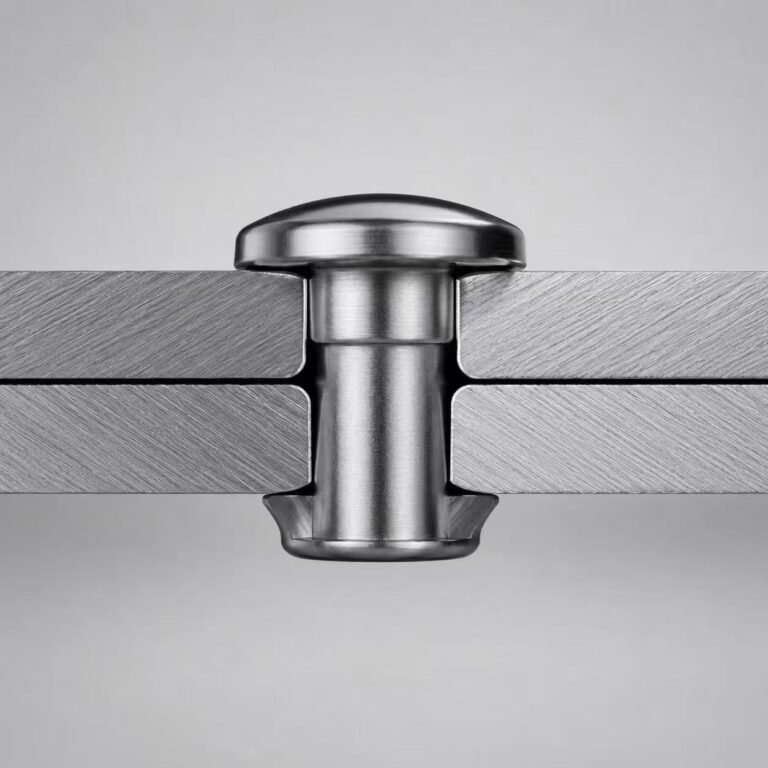
A rivet is a permanent fastener. It is a smooth shaft with a head on one end. You put the rivet through a hole in two or more pieces of material. Then, your industrial riveting solutions deform the plain end of the rivet. This action creates a second head on the opposite side. The material is now locked forever. You cannot remove a rivet without destroying it. This makes rivets perfect for heavy loads.
What is an Eyelet or Grommet?
An eyelet is a metal ring with a flange. It clears a hole in the material and flattens out on the back. Sometimes people use a matching washer with it. This creates a smooth metal rim around the hole. The primary job of an eyelet is to protect the material from tearing. It allows ropes, cords, or hooks to pass through the hole smoothly without causing friction damage.
3. Snap Buttons: Reusable Convenience for Modern Products
We use snap buttons when we need convenience. They are very popular in consumer goods because they are very easy to use.
3.1 Best Applications
You can find snap buttons on winter jackets, boat covers, and child car seats. They also work well on leather wallets, medical gowns, and electronic cases. They are ideal for any product that needs regular opening and closing.
3.2 Materials and Design Options
Manufacturers make snap buttons from brass, stainless steel, and plastic. Brass is popular because it does not rust easily. Stainless steel is stronger and handles outdoor weather well. Plastic snaps are lightweight and come in many bright colors. You can print your company logo on the metal caps to make your brand look professional.
3.3 Pros and Cons
The main advantage is reusability. They are easy to open with your hands. They also give a clean appearance to garments. However, they have limits. They cannot hold heavy structural weights. If you pull them too hard, they can rip out of weak fabrics. They also require high-precision automated fastener installation equipment to attach all four parts correctly.
4. Rivets: Maximum Strength for Permanent Fastening
When you need the strongest joint possible, you should choose rivets. They are the backbone of structural assembly lines.
4.1 Ideal Use Cases
We use rivets in automotive chassis, computer cabinets, and metal furniture. They are perfect for folding chairs, roller skate bases, and heavy-duty sheet metal enclosures. If your product experiences shaking or heavy vibrations, you must use rivets.
4.2 Engineering Advantages
Rivets create an incredibly strong mechanical bond. They expand inside the hole during installation. This expansion fills any gaps completely. They do not loosen over time like screws do. They can join different types of materials together, such as aluminum and plastic, without any heat damage.
4.3 Limitations to Consider
The biggest limitation is that rivets are permanent. If you make a mistake during assembly, you have to drill the rivet out. This can destroy your workpiece. Also, the installation process requires significant mechanical force. You need a robust rivet machine to apply this force safely and consistently.
5. Eyelets: Hole Reinforcement and Protection Experts
Eyelets do not always hold two separate pieces together. Their main job is to reinforce a pre-cut hole.
5.1 Common Applications
You can see eyelets on shoes, clothing tags, and outdoor banners. They are also vital for tarpaulins, curtains, and industrial packaging bags. They allow wires or ropes to pass through materials without tearing the edges.
5.2 Functional Benefits
Without an eyelet, a rope will quickly shred a fabric hole. The metal barrel covers the raw edge of the material. This stops fraying and tearing. Eyelets are very cheap to buy in large quantities. They also run very fast on automated assembly lines if you use a high-quality eyelet machine.
6. Direct Comparison: Snap Button vs Rivet vs Eyelet
To help you decide quickly, we have created a direct comparison table. This table shows the performance metrics for each fastener type based on standard industrial testing.
| Feature | Snap Button | Industrial Rivet | Eyelet / Grommet |
|---|---|---|---|
| Connection Type | Temporary / Reusable | Permanent | Permanent (Hole Lining) |
| Tensile Strength | Low (Breaks apart under pull) | Extremely High | Medium |
| Vibration Resistance | Poor (Can pop open) | Excellent (Does not loosen) | Good |
| Primary Material | Brass, Steel, Plastic | Steel, Aluminum, Copper | Brass, Steel, Aluminum |
| Installation Machine | Snap Button Machine | Rivet Machine | Eyelet Machine |
| Production Cost | Medium to High | Low per unit | Very Low per unit |
7. Industry-Specific Application Guide
Different industries require different fastening strategies. Let us look at how these fasteners perform in specific factory environments.
7.1 Apparel & Fashion
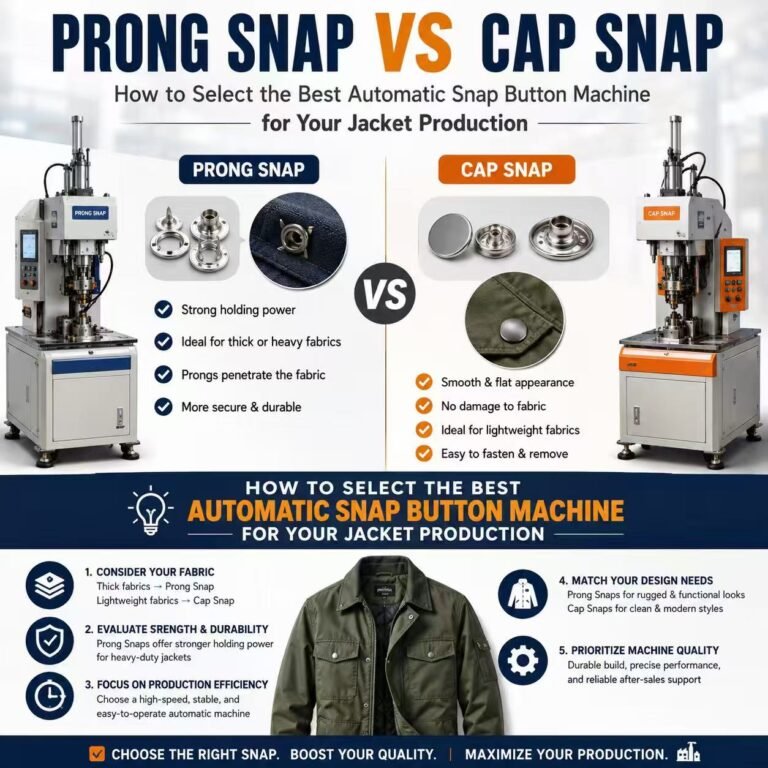
In our experience with fashion brands, snap buttons and eyelets dominate this area. Jackets use prong snaps or cap snaps for easy closure. Shoes use rows of small eyelets to hold shoelaces. You must make sure your fastener installation equipment does not pinch the delicate fabric, or the fabric will tear around the metal parts later.
7.2 Leather Goods & Accessories
Leather bags and belts use all three types. Heavy rivets hold the main handles to the bag body because handles carry all the weight. Snap buttons close the pockets securely. Eyelets decorate the strap holes and protect them from expanding under tension.
7.3 Automotive & Electronics
This sector requires extreme precision. Car factories use automated orbital riveting systems to join internal parts. Electronic companies use small brass rivets to secure circuit boards and metal chassis. Screws can back out due to engine vibrations, but rivets stay tight forever. This makes them crucial for safety-critical components.
7.4 Outdoor, Sporting Goods & Industrial
Outdoor gear must survive wind and rain. Tents and flags use large eyelets to anchor ropes to the ground. Specialized sporting goods, like roller skates, use thick steel rivets to mount the wheel base to the shoe sole. This prevents the heavy frame from splitting away from the boot during high-speed movements.
7.5 Packaging & Specialty Materials
Heavy cardboard boxes, luxury wine packages, and industrial sample books use eyelets. The eyelet acts as a pivot point. This allows the packaging layers to fan out smoothly without tearing the paper layers apart.
8. The Critical Role of Professional Installation Machinery
You cannot install industrial fasteners using hand tools if you run a real factory. Hand tools are too slow. They also create uneven pressure. One worker might press hard, while another worker might press lightly. This creates inconsistent quality control.
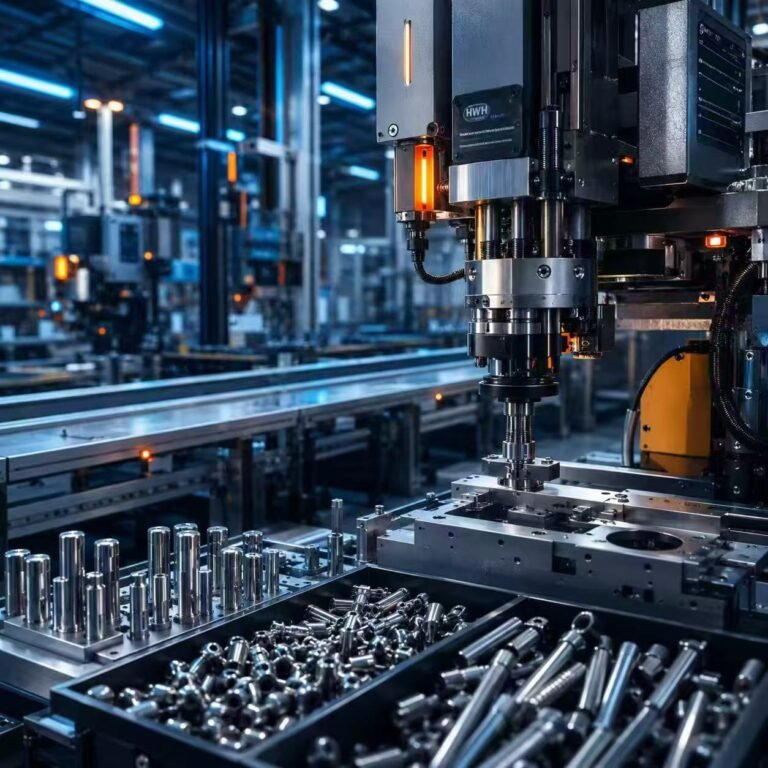
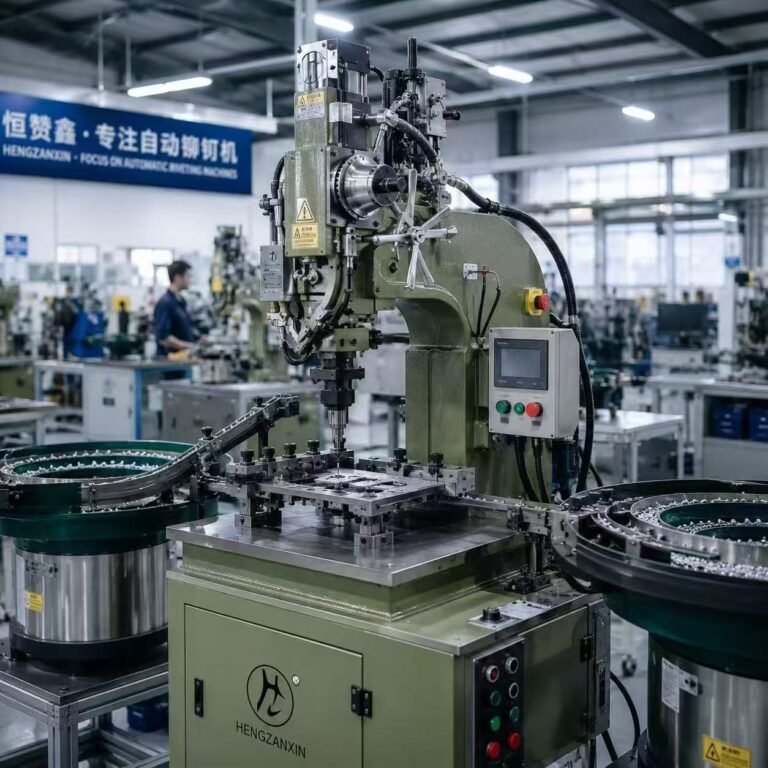
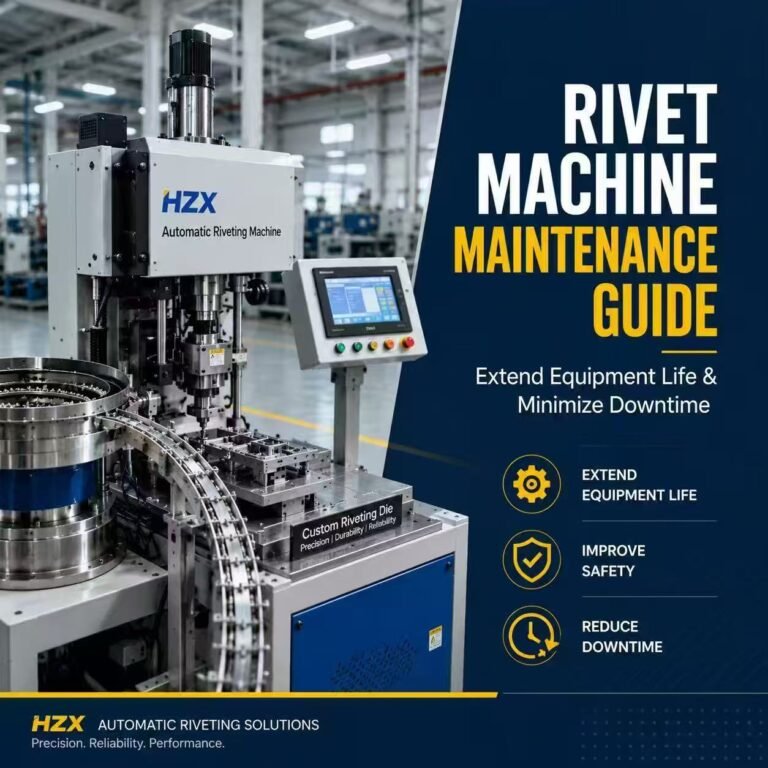
An automated snap button machine or rivet machine solves this problem completely. Modern machines use pneumatic or hydraulic force to deliver the exact same pressure every single cycle. They also feature automatic feeders. These feeders slide the metal parts into the dies automatically. This protects the fingers of your operators and speeds up your production rate by up to 500 percent.
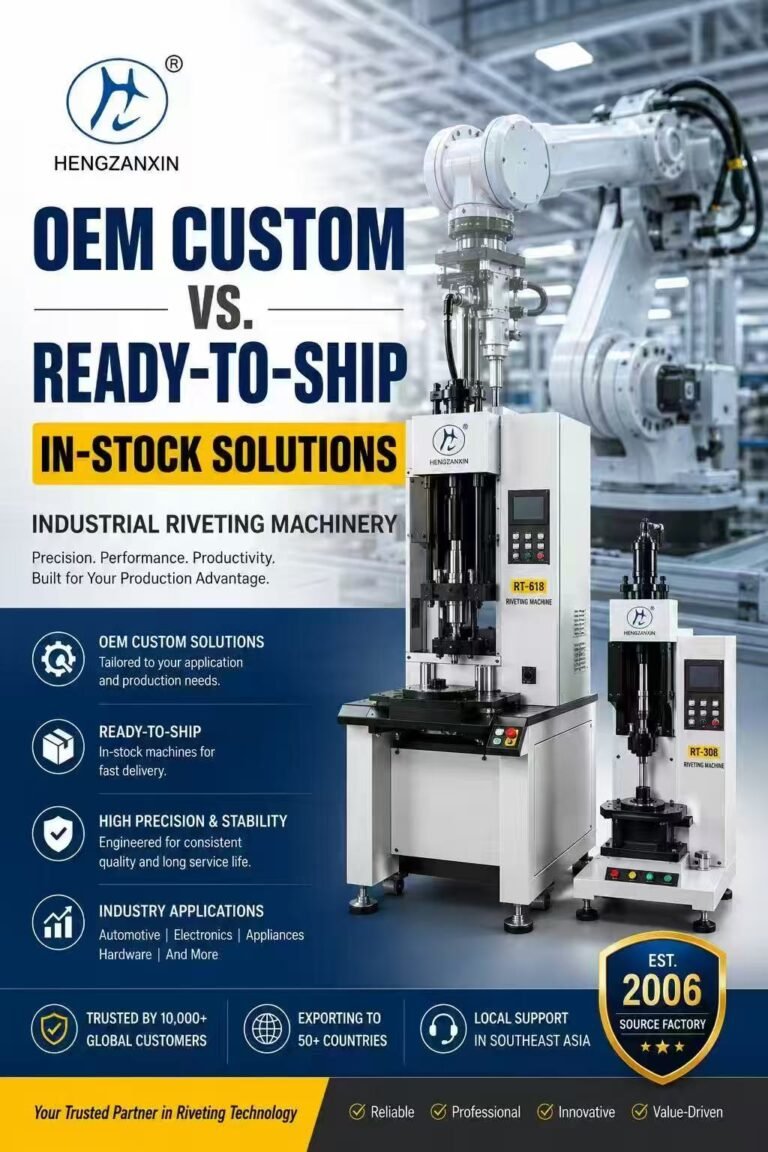
9. HZX Riveting and Automation Solutions Advantage
Hengzanxin (HZX) is a direct source factory located in Houjie, Dongguan, China. We have over 20 years of technical engineering experience. We build high-precision machinery designed to run 24 hours a day without breaking down.
9.1 Key Machine Models for Fasteners
We manufacture a wide range of standard and non-standard machines inside our 3,000-square-meter facility. Here are our most popular models for fastener installation:
| Model Number | Machine Type & Application | Best For |
|---|---|---|
| HZX-R250SA | Heavy Duty Automatic Twin Riveting Machine | Hardware parts and double joints |
| HZX-DR5TDA | 5-Ton Heavy Duty Automatic Double Head Riveting Machine | Automotive chassis and heavy metalwork |
| HZX-E150TA | Automatic Tabletop Eyelet Punching Machine | Clothing tags, shoes, and light fabrics |
| HZX-E135TA | Automatic Tabletop Eyelet Grommet Machine | Banners, leather goods, and industrial packaging |
| HZX-O06SP | Pneumatic Tabletop Orbital Riveting Machine | High-end electronics and delicate components |
| HZX-R5400SP | Automatic Roller Skate Base & Sole Riveting Machine | Sporting equipment and heavy plastic bonding |
9.2 Non-Standard Customization Process
Every piece of hardware has slightly different sizes. A standard feeding bowl will jam if your rivets are one millimeter longer than normal. That is why HZX focuses on non-standard customization. We do not just ship a generic machine. Our R&D team asks you to send us your material drawings or physical workpieces. We then use our CNC machine tools to shape custom feeding molds that match your exact hardware geometry.
9.3 Plug-and-Play Efficiency & ROI Benefits
We test every machine inside our factory before we pack it in export-standard wooden boxes. When the machine arrives at your workshop, it is fully configured. Your workers can simply plug it in and start manufacturing immediately. This plug-and-play design drastically reduces your setup time. It delivers a fast return on investment by eliminating assembly line downtime from day one.
10. Installation Best Practices for Snap Buttons, Rivets, and Eyelets
To avoid factory errors, your production team should follow these strict operational rules:
- Check material thickness: Your rivet shank must be longer than the total thickness of your materials. If it is too short, the second head will not form correctly.
- Align the dies perfectly: If the upper die does not match the lower die, the eyelet barrel will split unevenly and scratch your customers.
- Keep the feeders clean: Dust and small metal shavings can collect inside the feeding tracks. Clean them with compressed air every shift to avoid machine jams.
- Monitor pressure settings: Soft leather requires less pressure than sheet metal. Adjust your pneumatic valves when you change product batches.
11. FAQ
11.1 Which fastener is the strongest?
The industrial rivet is the strongest choice. It creates a solid metal bond that resists vibrations and heavy shear forces. It cannot be opened without destroying the fastener itself.
11.2 Can snap buttons be used on leather?
Yes, they work very well on leather products. However, you must use a dedicated snap button machine to apply the correct pressure. Too much force will crush the leather, while too little force will cause the snap to pull out.
11.3 Are eyelets waterproof?
Standard eyelets have a hole in the middle, so water can pass through them. If you need a waterproof seal, you must use a special solid grommet with a rubber washer. You also need high-pressure machinery to crimp it tightly.
11.4 Can one machine handle all three fasteners?
Generally, no. A snap button machine requires four-part feeding systems. A rivet machine handles solid or semi-tubular metal pins. An eyelet machine uses a punching and curling mechanism. You should buy specialized machines to maintain high speed and prevent damage.
11.5 What causes installation failures?
Most failures happen because of poorly matched feeding molds or wrong pressure settings. Using low-quality hardware with inconsistent dimensions will also cause the feeding bowls to jam constantly.
11.6 Are rivets suitable for thin materials?
Yes, you can use small aluminum rivets on thin sheet metals or plastics. If the material is extremely soft, you should place a backup washer on the tail side. This washer distributes the force and prevents the rivet from pulling through the material.
12. Conclusion: Partner with HZX for Smarter Fastening Solutions
Choosing between snap buttons, rivets, and eyelets depends entirely on your product goals. If you need a temporary opening, pick snap buttons. If you need extreme structural strength, pick rivets. If you need to protect a hole, pick eyelets. No matter which option you select, you need professional industrial riveting solutions to keep your factory running smoothly. Hengzanxin is ready to engineer the perfect machine for your business needs.
Contact the HZX engineering team today. Send us your hardware drawings, and we will design a custom, plug-and-play machine configuration for your production line within 24 hours.