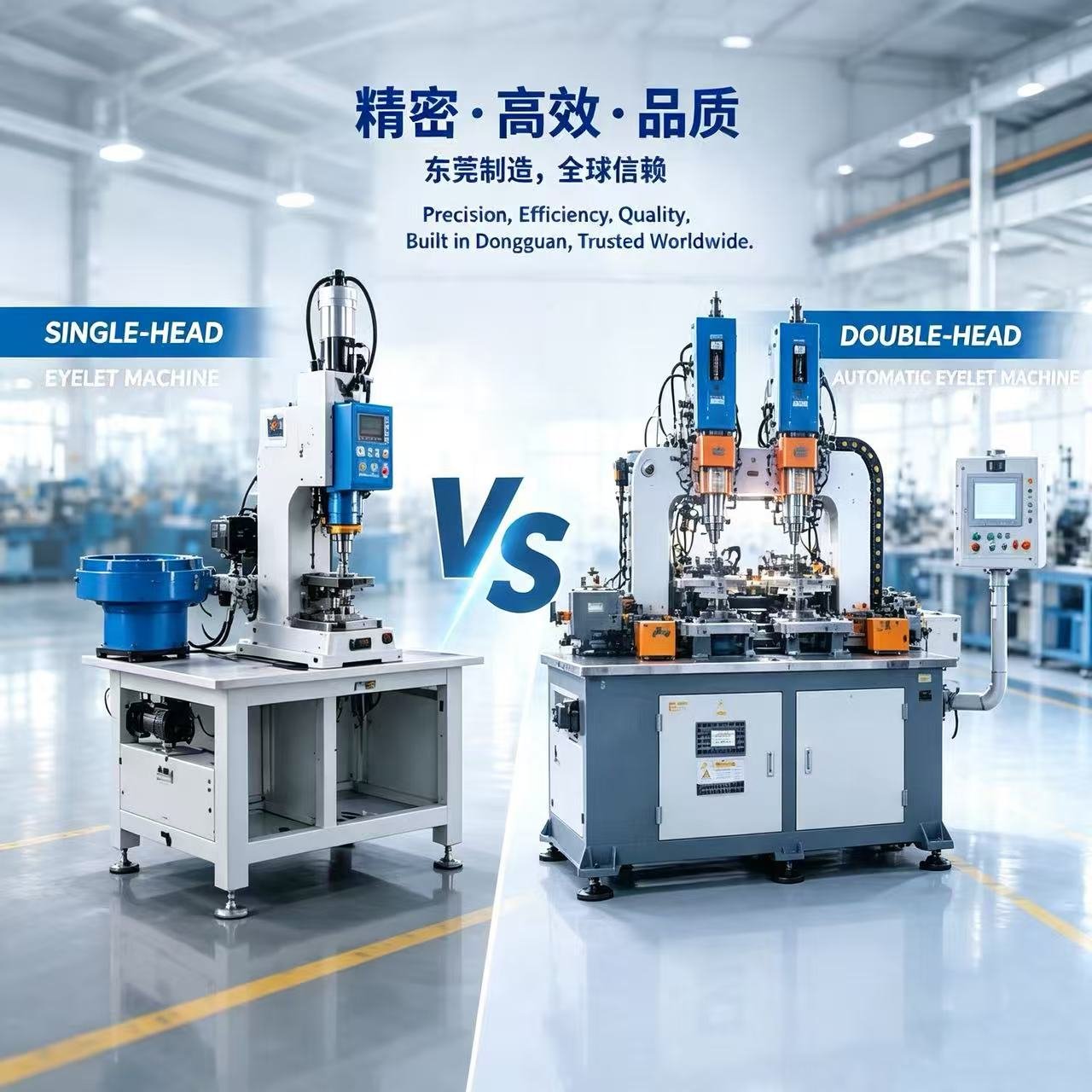
Single-Head vs Double-Head Eyelet Machine: Which Solution Gives Your Factory the Best ROI?
Are you struggling to choose between a single-head eyelet machine and a double-head eyelet machine? This guide compares real machine performance, 3-year operating costs, and factory output. You will discover which eyelet machine model lowers your production costs and maximizes your long-term return on investment.
Table of Contents
- 1. Core ROI Perspective for Eyelet Machinery
- 2. Investment and Cost Structure Analysis
- 3. Output Speed and Labor Efficiency Comparison
- 4. Durability, Maintenance, and Lifecycle Value
- 5. Application Fit and Material Compatibility
- 6. HZX Customization and Factory Integration Advantages
- 7. Step-by-Step Decision Checklist for Factory Buyers
- 8. Conclusion and Actionable Recommendation Path
1. Core ROI Perspective for Eyelet Machinery
Return on investment (ROI) determines the real value of your factory equipment. Many plant managers focus only on the sticker price of a new machine. You must look deeper into long-term daily performance and long-term operating costs. A cheap machine can become expensive if it slows down your production lines.
Production Volume Drives Your Machine Selection
Your daily production volume is the most important factor in this choice. You must count how many eyelets your operators attach every shift. If your factory processes under 500 units per day, a single-head eyelet machine provides a flexible and affordable option. Small workshops often prefer this setup because custom work requires frequent setup adjustments.
Large factories need a different approach. If your production volume exceeds 2,000 units per day, single-head units create clear production bottlenecks. A double-head eyelet machine allows you to attach two eyelets at the same time. You immediately double your daily volume without hiring extra operators. High production volume makes the double-head model much more profitable over time.
Total Cost of Ownership (3–5 Years) vs Upfront Purchase Price
The upfront purchase price represents only a small part of your total investment. You must calculate the Total Cost of Ownership (TCO) across three to five years. This total cost includes purchase price, power usage, maintenance, labor salaries, and wasted raw materials.
You can see how initial savings quickly vanish if a machine requires extra labor. A single-head eyelet punching machine costs less on day one, but it requires double the labor time for two-hole jobs. A double-head automatic eyelet machine costs more on day one, but it saves thousands of dollars in operator salaries every year. You recover the extra equipment price within months of continuous operation.
Matching Machine Capabilities with Actual Workpiece Requirements
You must match machine features directly with your products. Every material reacts differently under mechanical pressure. Thin fabrics require precise feeding mechanisms. Heavy canvas or metal sheets need powerful hydraulic or pneumatic pressing power.
Hengzanxin (HZX) designs every industrial eyelet machine around specific workpiece needs. You must check whether your product needs precise hole spacing. A double-head model locks both eyelets into fixed positions. This feature prevents human alignment errors. A single-head model relies entirely on operator eye measurement for the second hole. You risk higher scrap rates if your products require perfect symmetry.
2. Investment and Cost Structure Analysis
Financial clarity helps you make safe machinery investments. You must compare upfront equipment spending against expected operational savings. Buying directly from a source factory helps you maintain healthy cash flow.
Upfront Capital Range and Payback Windows
Prices vary depending on automation levels, motor power, and frame strength. A basic single-head eyelet machine usually costs between $4,000 and $8,000. This price fits small budgets and prototype workshops. The payback window for a single-head machine usually spans four to eight months for small orders.
A heavy-duty double-head eyelet machine costs between $12,000 and $20,000. This machine processes two holes together with automated material feeding systems. The payback window for a double-head machine drops to three to six months in medium or high-volume plants. The extra output speed pays back the higher machinery cost very quickly.
Ongoing Operating Expenses: Power, Tooling, Labor, and Spare Parts
You must track daily running costs to protect your profit margins. Power usage remains relatively equal between both machine types because efficient electric and pneumatic motors drive the punching heads. Tooling costs depend on raw material hardness. High-quality alloy molds from HZX resist wear and lower your long-term mold replacement expenses.
Labor represents your largest ongoing expense. One single-head machine needs one dedicated operator to punch each hole sequentially. A double-head machine allows one operator to complete two holes in a single step. You reduce your direct labor cost per unit by 50 percent on multi-hole workpieces.
| Cost & Operational Factor | Single-Head Eyelet Machine | Double-Head Eyelet Machine |
|---|---|---|
| Average Initial Investment | $4,000 – $8,000 | $12,000 – $20,000 |
| Typical Payback Period | 4 – 8 Months | 3 – 6 Months (at high volume) |
| Labor Requirement | 1 Operator per hole cycle | 1 Operator for dual hole cycle |
| Labor Cost per 100,000 Units | Higher (Double press actions) | 30% to 50% Lower |
| Annual Maintenance Budget | $300 – $600 | $500 – $1,000 |
| Required Floor Space | Small footprint (Compact) | Medium footprint (Integrated bench) |
How Source Factory Direct Supply and Ready Stock Improve Cash Flow
Buying through middle distributors adds unnecessary markup fees to your equipment budget. HZX operates as an active source factory in Dongguan, China. You receive factory-direct pricing without distributor markups. This direct purchasing model keeps your upfront capital costs low.
HZX maintains a massive inventory of standard machinery and pre-built components. Fast order processing means your equipment ships without long manufacturing delays. You can put your new grommet machine into production immediately. Quick deployment helps you start generating revenue right away, which strengthens your operational cash flow.
3. Output Speed and Labor Efficiency Comparison
Production speed controls your factory capacity and delivery schedules. You must analyze cycle times and labor savings to evaluate your production line performance.
Real Cycle Times and Eyelets-Per-Minute in Continuous Operation
Speed claims on paper must match real workshop performance. A manual or semi-automatic single-head machine processes under 30 eyelets per minute during continuous operation. The operator must move the material manually after every press. Operator fatigue slows down production speed as the work shift progresses.
An automatic double-head eyelet machine processes over 60 eyelets per minute under continuous operation. Dual automated punching heads set two fasteners simultaneously. The double-head eyelet machine increases factory output by up to 300 percent compared to single-head machines. Automated material positioning guarantees fast cycle times throughout the entire workday.
Labor Savings: Dual-Head Simultaneous Punching vs Sequential Single-Head Punching
Sequential punching on a single-head machine requires multiple manual steps. The operator aligns the workpiece, presses the foot switch, moves the fabric, aligns the second mark, and presses the foot switch again. This process increases production time and creates opportunities for alignment mistakes.
Dual-head punching combines these actions into a single fluid step. The operator places the workpiece onto the adjustable workbench. The dual-head mechanism punches holes and sets both eyelets at the exact same moment. You cut handling steps in half. Your workers accomplish more volume with less physical effort, which reduces workplace fatigue and turnover.
| Productivity Metric | Single-Head Eyelet Machine | Double-Head Eyelet Machine |
|---|---|---|
| Maximum Output Speed | Below 30 Eyelets / Minute | Above 60 Eyelets / Minute |
| Punches per Action | 1 Eyelet set per cycle | 2 Eyelets set per cycle |
| Shift Output Capacity (8 Hours) | Approx. 3,000 – 5,000 units | Approx. 10,000 – 15,000 units |
| Spacing Accuracy | Manual operator positioning | Fixed mechanical hand-wheel setting |
| Scrap Rate Target | 1% to 3% (Operator variable) | Under 0.5% (Mechanically locked) |
Consistency Gains That Reduce Rework, Scrap, and Material Waste
Manual positioning causes spacing variations on finished products. A worker might place eyelets two millimeters off center on a heavy canvas curtain or folding chair fabric. Misaligned eyelets look unprofessional and ruin expensive materials. Reworking defective products wastes valuable labor time and materials.
A double-head automatic eyelet machine uses mechanical guides and adjustable spacing bars. You set the distance between two eyelets using a hand-wheel mechanism. The machine maintains exact measurements across thousands of cycles. Perfect structural symmetry cuts scrap rates below 0.5 percent. You save money by eliminating wasted materials.
4. Durability, Maintenance, and Lifecycle Value
Industrial machinery must withstand aggressive daily use. Machine breakdowns delay client orders and harm your business reputation. You need durable equipment built with high-quality components.
Structural Machine Design and Heavy-Duty Motor Longevity
HZX builds all eyelet machines in a modern 3,000-square-meter facility in Dongguan. Our production floor uses high-precision CNC machine tools to produce robust steel frames and durable drive shafts. Heavy structural frames absorb punching vibrations, which keeps internal mechanical parts aligned during high-speed operation.
Industrial-grade electric motors and hydraulic power units deliver stable punching force. HZX machinery leverages over 20 years of factory engineering expertise to deliver durable structures and reliable long-term performance. High-strength motor components prevent overheating during continuous heavy-duty operations.
Maintenance Intervals and Preventing Workshop Downtime
Regular maintenance protects your machinery investment. Standard maintenance tasks include clearing material dust, lubricating guide rails, and checking belt tension. Single-head models feature simple mechanical drives that require minimal maintenance. Small workshops can service these units easily with basic hand tools.
Double-head machines use dual feeding tracks and synchronized drive systems. These systems require regular inspection to keep both feeding channels running smoothly. HZX integrates clear access panels and centralized lubrication points into every double-head eyelet punching machine. Simple access points reduce routine maintenance time and keep your production lines running.
Warranty Coverage and Long-Term Parts Availability from HZX
Unexpected machine failures cost money in lost production time. HZX protects your purchase with a one-year complete warranty on standard machinery. Our service team responds to technical requests within 12 to 24 hours to keep your equipment running smoothly.
HZX maintains a full inventory of replacement feeding channels, punching dies, and drive pins. Standardized factory manufacturing ensures that replacement parts fit your equipment perfectly. You can order spare components directly from our factory floor without waiting for custom manufacturing.
5. Application Fit and Material Compatibility
Different manufacturing sectors require specific equipment features. You must choose a machine that matches your raw materials and product designs.
When a Single-Head Eyelet Machine Fits Best
Single-head units excel in flexible production environments that handle small orders and custom shapes. Apparel makers, custom shoemakers, and prototype labs benefit from single-head agility. A single-head eyelet machine allows operators to navigate tight corners, curved seams, and isolated attachment points effortlessly.
Custom work requires fast changes between eyelet sizes. Changing a single set of feeding chutes and punching dies takes only a few minutes. If your shop processes small batch orders with varying hole patterns, a single-head model gives you the flexibility you need.
When a Double-Head Eyelet Machine Is Necessary
Double-head models fit high-volume industrial lines that require uniform hole spacing. Banner printers, curtain manufacturers, tarpaulin makers, and folding chair factories rely on double-head machines. These applications require long rows of parallel eyelets with identical spacing.
Model HZX-E135TA sets dual grommets along fabric edges automatically. Double-head machines hold material flat and set both fasteners simultaneously, preventing fabric bunching. High-volume textile and hardware production lines require double-head speed to meet tight shipping deadlines.
| Industry & Product Category | Recommended Machine Type | Key Material & Feature Match |
|---|---|---|
| Curtains & Heavy Tarpaulins | Double-Head Eyelet Machine | Canvas, PVC, wide fabrics; needs uniform edge spacing |
| Roller Skates & Footwear | Specialized / Double-Head (e.g., HZX-R5400SP) | Thick leather, molded plastics; needs high-strength setting |
| Folding Chairs & Outdoor Gear | Double-Head (e.g., HZX-R4250A) | Steel tubing, heavy canvas; needs structural symmetry |
| Custom Leatherware & Apparel | Single-Head Eyelet Machine | Genuine leather, delicate textiles; needs flexible corner positioning |
| Electronic Enclosures & Sheet Metal | Press / Single-Head (e.g., HZX-O06SP) | Brass, aluminum, mild steel; needs high tonnage punching force |
Material Compatibility Across Fabrics, Metals, and Mixed Substrates
Eyelet machinery must process various materials without damaging workpieces. Soft fabrics like cotton or banner vinyl can tear if punching dies apply uneven pressure. Heavy canvas or plastic sheets require strong punching forces before setting fasteners.
HZX machinery handles brass, aluminum, steel, PVC, and multi-layer textiles. Our engineering team selects pneumatic, hydraulic, or motor-driven systems based on your material density. Correct pressure delivery prevents material deformation and creates clean, professional eyelet settings every time.
6. HZX Customization and Factory Integration Advantages
Standard off-the-shelf equipment does not always fit complex manufacturing operations. Non-standard parts need custom machinery solutions. HZX builds custom automated equipment tailored to your exact manufacturing needs.
In-House Mold and Feeding System Development
Custom eyelets and non-standard rivets often jam in generic automatic feeding tracks. HZX operates an experienced in-house R&D engineering team. Our engineers design custom feeding bowls, tracks, and punching molds based on your technical drawings.
Custom feeder tracks guide fasteners smoothly into position without tumbling or jamming. Precise mold tolerances protect fastener surfaces from scratches during punching. Custom tooling helps your factory handle unique hardware designs effortlessly.
Pre-Shipment Testing with Your Actual Materials and Workpieces
We test every custom machine thoroughly before it leaves our factory floor. HZX requires clients to send actual sample materials and workpieces for live testing before final machine delivery. Our engineering team uses your real samples to fine-tune feeding bowls, adjust punching forces, and set alignment guides.
Pre-shipment testing eliminates surprises when equipment arrives at your facility. We record video proof of sample testing so you can verify machine speed, feeding stability, and setting quality before paying your final balance. Thorough testing guarantees that your equipment arrives ready for production.
Plug-and-Play Machine Delivery for Immediate Production
Complicated installation steps delay production schedules and waste technical resources. HZX pre-assembles and pre-calibrates every factory direct eyelet machine before shipping. We ship machinery in secure, export-standard wooden crates to prevent damage during transit.
When the crate arrives at your workshop, your team unboxes the machine, connects electrical power, attaches your compressed air lines, and begins production immediately. “Plug-and-play” delivery minimizes installation downtime, helping you start earning returns on your equipment investment right away.
7. Step-by-Step Decision Checklist for Factory Buyers
You can use this practical decision guide to evaluate your production needs and choose the right eyelet equipment for your business.
Volume Thresholds and Shift Capacity
First, calculate your actual daily volume requirements across all product lines. You must choose equipment that handles both your current production demands and near-term business growth.
- Under 500 Eyelets / Day: Choose a single-head eyelet machine. Low volume does not justify the higher cost of a double-head unit.
- 500 to 2,000 Eyelets / Day: Evaluate your expansion plans. If order volumes are rising, choose a double-head machine to prevent future production bottlenecks.
- Over 2,000 Eyelets / Day: Choose an automatic double-head eyelet machine. High output speed will significantly lower your labor costs.
Hole Spacing Flexibility and Fast Changeover Times
Next, examine your product designs. You must determine how often your operators need to adjust hole spacing during a work shift.
- Fixed Parallel Patterns: Choose a double-head model. You can lock in hole spacing between 60 mm and 220 mm for fast, symmetrical output.
- Random or Highly Variable Patterns: Choose a single-head unit. Single-head models allow operators to navigate irregular paths without adjusting secondary heads.
Factory Utilities: Floor Space, Power, and Compressed Air
Verify that your factory floor has the space and power infrastructure required to support new machinery.
- Floor Space: A single-head unit fits easily into tight work areas. A double-head machine requires a wider bench footprint to support dual feeding channels.
- Pneumatic Supply: Check that your air compressor delivers steady pressure (typically 0.4 to 0.8 MPa) for high-speed pneumatic machinery.
- Electrical Power: Confirm that your factory supply matches the machine motor specifications (110V, 220V, or 380V options).
24-Month Growth Trajectory and Customization Needs
Plan for your future business requirements. Replacing undersized machinery after a few months of growth wastes time and capital.
- Standard Fasteners: Order standard HZX stock models for immediate dispatch.
- Custom Hardware Drawings: Contact HZX engineers to design custom feeder tracks, specialized molds, and custom automated machinery.
8. Conclusion and Actionable Recommendation Path
Choosing between a single-head eyelet machine and a double-head eyelet machine depends directly on your daily production volume, material requirements, and budget strategy. A single-head eyelet machine delivers excellent flexibility and low initial entry costs for small workshops, short product runs, and custom work. You protect your capital while maintaining the ability to process custom fastener applications.
A double-head eyelet machine provides superior ROI for medium-to-high volume manufacturing operations. Dual simultaneous punching heads increase output speed, eliminate alignment errors, cut scrap rates, and lower per-unit labor costs. You recover the higher purchase price quickly through daily operating savings and higher production capacities.
Hengzanxin (HZX) supports your equipment purchase every step of the way. Operating as a direct source factory in Dongguan since 2006, HZX combines modern CNC manufacturing with experienced in-house automation R&D. We help you eliminate purchasing risks through free sample testing, custom drawing reviews, and fast technical support.
Ready to Boost Your Production Efficiency?
Contact HZX engineers today to discuss your industrial machinery requirements:
- Send us your sample materials and hardware drawings for custom feeding validation.
- Receive a detailed custom quotation within 12 to 24 hours.
- Enjoy direct source factory pricing, standard equipment stock, and full 1-year warranty coverage.